Software Selection& Vendor Advisory
Buying business software well is a discipline. Requirements written down before anyone sees a demonstration, options compared on the same basis, and a recommendation you can still defend in two years.
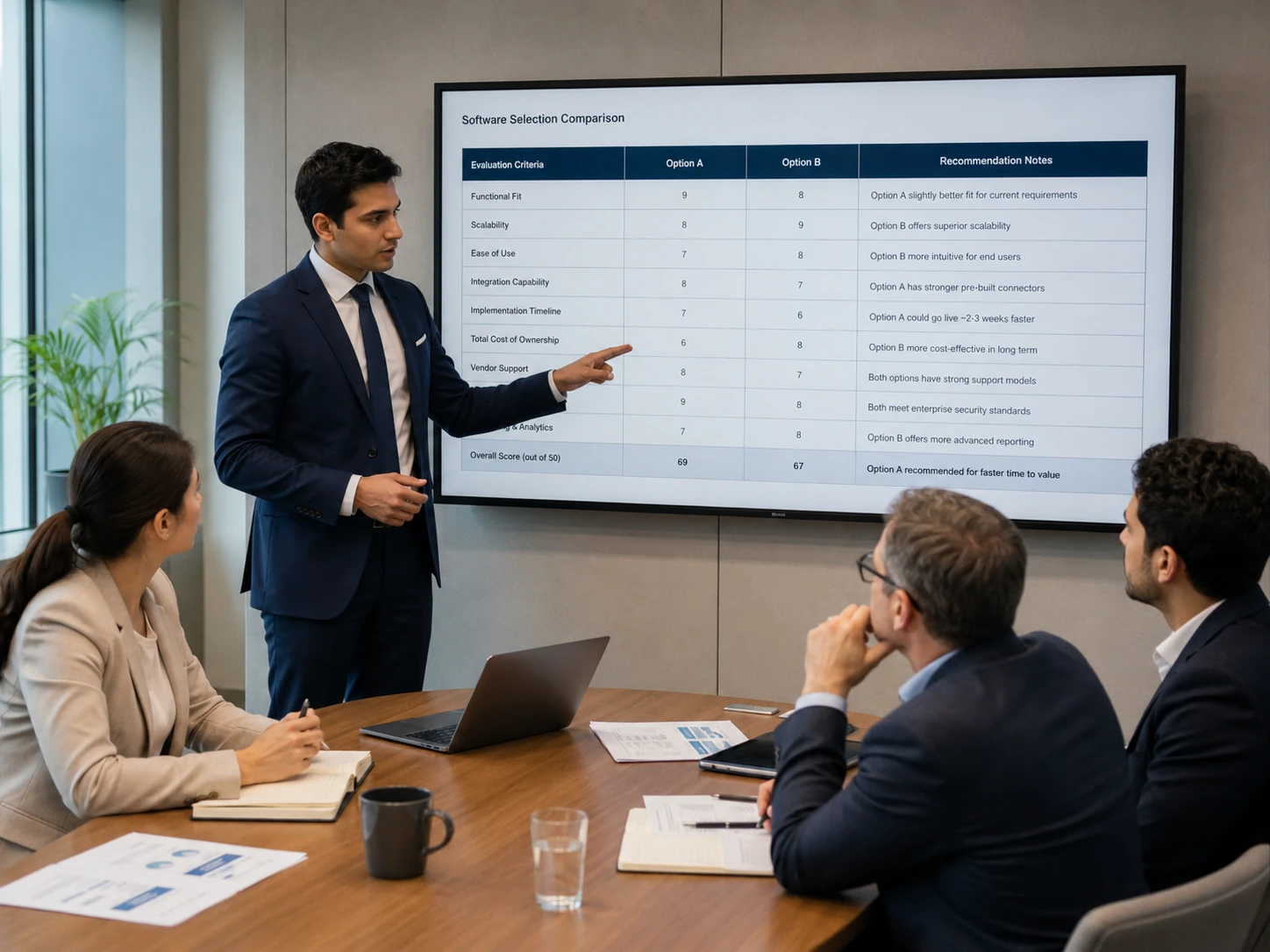
A demonstration shows you what a product does well. It is designed to. The work is finding out what it does badly.
We are not a reseller. That is the entire point.
Most software advice in the market comes from organisations that implement, resell or receive referral fees from a particular product. That does not make them dishonest, but it does mean their conclusion is knowable in advance.
Alvoris holds no reseller agreements, no partner status and no referral arrangements with software vendors. We are paid for the selection work, not for the outcome, and we do not implement the product we recommend unless you separately ask us to.
That leaves us free to reach the conclusions the evidence supports — including “none of these are worth the disruption” and “the product you already own would do this if it were configured properly”.
How software purchases go wrong.
- 01Requirements written after the shortlistIf the specification is assembled from what the products offer, the evaluation has already been decided. Requirements have to come first.
- 02Demonstrations driven by the vendorA vendor-led demonstration shows a curated path through the product. Scripting the demonstration around your own scenarios changes what you learn from it.
- 03Comparison on licence price aloneImplementation, migration, training, integration, support and the internal effort of change frequently exceed the licence cost in year one.
- 04Nobody asked about getting the data outExport capability is rarely examined at purchase and becomes decisive later. It should be a scored criterion, not an afterthought.
- 05The awkward requirement is deferredThe one process that does not fit is often the one that matters commercially. It should be tested hardest, not set aside for later.
- 06The decision cannot be explained afterwardsWhen the rationale exists only in a conversation, it does not survive staff changes or scrutiny. A scored evaluation leaves a defensible record.
Requirements first. Options second. Never the other way round.
The funnel narrows deliberately, and at every narrowing the reason for exclusion is recorded — which is what makes the final choice defensible.
What the engagement includes.
Scope is agreed in advance and stated in the quotation.
Typical selection engagements.
Five stages over three to six weeks.
Vendor availability is usually the limiting factor. We manage that correspondence so your team is not chasing sales representatives.
- Stage 01Requirements and criteriaInterviews, process review, and a written requirements document with weighted evaluation criteria. Signed off before we look at any product.
- Stage 02Market survey and longlistCandidates identified and assessed against the mandatory requirements, with exclusions recorded and explained.
- Stage 03Shortlist and demonstrationsThree or four products taken forward. We write the demonstration scripts, attend the sessions and score against the agreed criteria.
- Stage 04Cost, references and riskFull three-year cost assembled, reference conversations held where possible, and implementation risk assessed for each option.
- Stage 05Recommendation and presentationWritten report with the scored comparison and a stated recommendation, presented to your team or board with time for challenge.
What you hold at the end.
- A written requirements document you own and can reuse
- Weighted evaluation criteria agreed in advance
- A longlist with recorded reasons for exclusion
- A scored comparison matrix across the shortlist
- Three-year total cost analysis per option
- A written recommendation with reasoning and residual risks
- Negotiation and implementation considerations
And who it is not for.
A good fit
- Organisations facing a purchase significant enough to justify getting it right
- Anyone who has been shown three demonstrations and become less certain
- Boards or trustees needing a defensible, documented decision
- Businesses weighing a bespoke build against available products
- Organisations approaching a renewal without having tested the market
Probably not a fit
- Low-value purchases where the evaluation would cost more than the software
- Decisions already made, where a report is wanted as justification
- Formal public procurement requiring specialist procurement expertise
- Situations needing implementation resource rather than a selection decision
Often taken alongside this one.
Frequently asked.
No. Alvoris Software Ltd holds no reseller agreements, partner status or referral arrangements with software vendors, and receives no payment of any kind from a supplier in connection with a recommendation. Our fee comes from you and nowhere else.
If that ever changed for a particular product category, we would declare it before the engagement began rather than in a footnote.
It happens, and it is a genuine conflict of interest, so we handle it explicitly. The build option is costed on the same basis as the products, using realistic figures rather than optimistic ones, and the recommendation states plainly that we are capable of doing that work.
You are under no obligation to engage us for it. Several clients have taken our requirements document and build estimate to another developer, which is a perfectly reasonable use of the work.
Yes, if you want us to. We can approach suppliers, issue the requirements, arrange and script demonstrations and manage the correspondence — which keeps your team out of a sales process. Some clients prefer to hold the relationship themselves and have us in the room for the evaluation only. Either arrangement works.
We can advise on the commercial and technical points worth pressing — term length, price protection, data export obligations, support response commitments, exit provisions. We are not solicitors and do not provide legal advice; for the contract itself you should take proper legal review.
Typically eight to fifteen candidates at longlist, narrowed to three or four for detailed evaluation. Evaluating more than four properly is rarely worthwhile — the effort per option is significant and the ranking seldom changes below fourth place.
Every excluded product has a recorded reason, so the longlist itself is a useful document.
Implementation of a third-party product is normally carried out by the vendor or their implementation partner, and that is usually the right arrangement. We can remain involved in a client-side role — reviewing the implementation plan, testing against the original requirements and holding the supplier to what was demonstrated — if that would be useful. It is quoted separately.