IT Estate Rationalisation& Cost Review
Every application, licence and subscription in a single inventory — with who uses it, what it costs, what it overlaps with, and what would actually be involved in removing it.
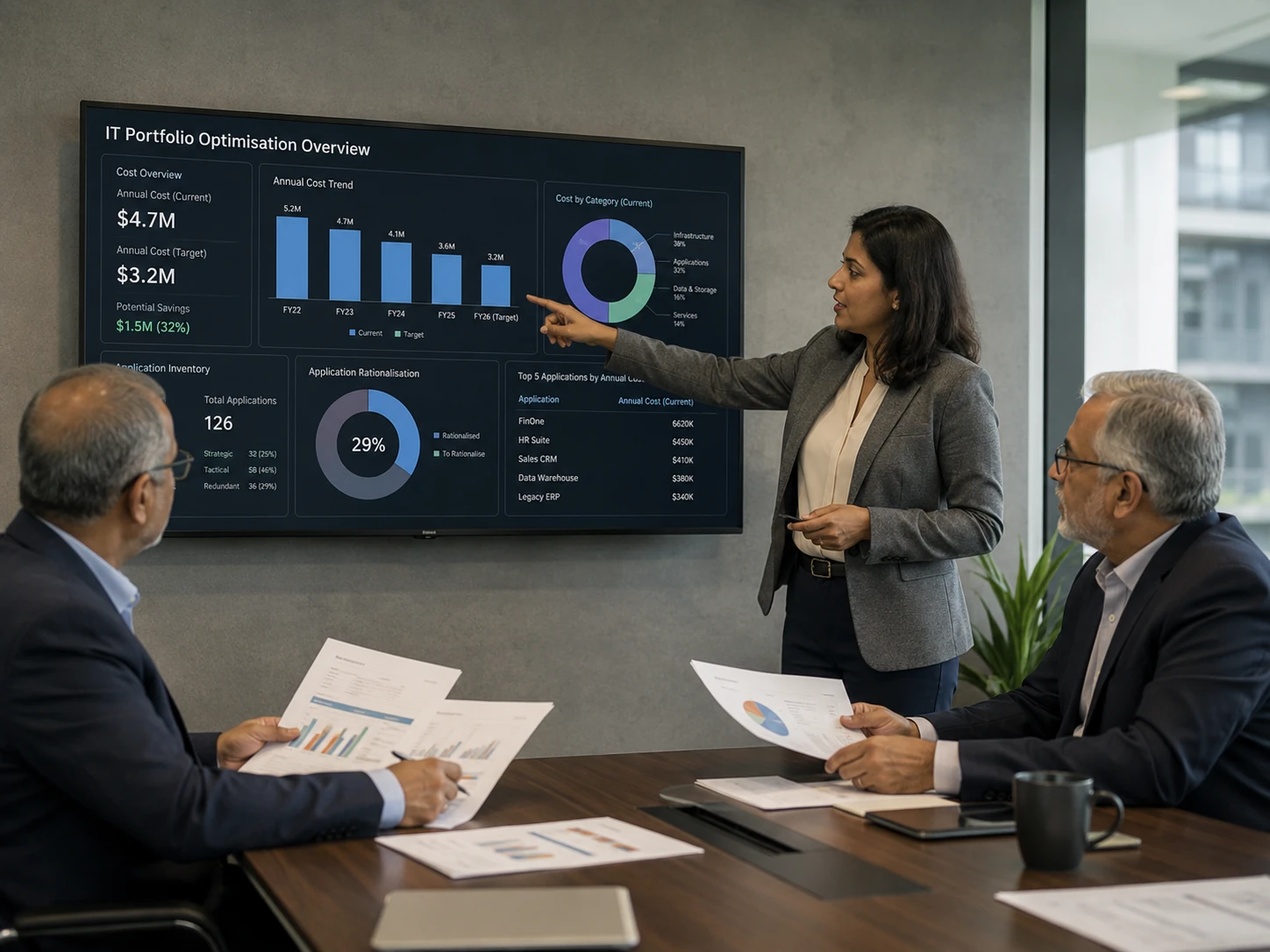
Nobody decided to run four tools that do the same job.
Software estates grow through a series of individually reasonable decisions. A department buys something urgently. A trial is never cancelled. An acquisition arrives with its own stack. A manager leaves and their subscription carries on billing.
The result is rarely dramatic and almost always expensive: several tools covering the same ground, licences for people who left, and an annual spend that nobody has examined as a whole because it is spread across departments and payment methods.
This engagement produces the list nobody has assembled, and then does the harder part — working out what can realistically be removed, in what order, and what removing it would actually cost.
What this service is built to address.
“We do not have a single list of what we pay for.”
Software spend spread across departmental cards, expense claims and direct debits is invisible in aggregate. Assembling the list is frequently the most valuable output on its own.
“Subscriptions have gone up every year and nobody can say why.”
Per-seat pricing grows with headcount whether or not the seats are used, and annual uplifts compound quietly. Both are correctable once visible.
“Three departments bought three different tools for the same thing.”
Consolidation needs a decision and an owner. The review supplies the evidence for that decision and an honest view of the migration effort.
“We are still paying for people who left.”
Licence reclamation is usually the fastest saving available, and the easiest to verify. It is also the one most often deferred because no one owns it.
“That renewal went through automatically again.”
Auto-renewal without review is a recurring commitment made by default. A calendar of renewal dates and notice periods changes that permanently.
“We think that system is still in use, but we are not sure.”
Assumed usage is rarely accurate. Establishing actual usage frequently reveals systems retained out of caution rather than need.
From accumulated estate to intended estate.
The target estate is not the smallest possible estate. It is the one where every remaining item has an owner, a purpose and a justified cost.
What the review produces.
When organisations commission this.
Five stages over two to five weeks.
Assembling the inventory usually requires cooperation from finance as well as from the people using the systems. We ask for that access at the outset.
- Stage 01Discovery and inventory assemblyCombining finance records, administrator consoles and departmental knowledge into one list. The list is nearly always longer than expected.
- Stage 02Usage and cost analysisLicences against active accounts against real use, and the full annual cost of each system including the parts that are not invoiced.
- Stage 03Overlap and dependency assessmentWhat duplicates what, and what depends on what — because the second question determines whether the first can be acted on.
- Stage 04Consolidation planningA sequenced plan with migration effort, renewal timing and risk stated for each step, and the saving attached to each one.
- Stage 05Report and working sessionWritten report plus a session with your finance and operational leads, so decisions can be taken while the detail is fresh.
What you hold at the end.
- A maintainable application and licence inventory
- Cost analysis per system with total annual spend
- Usage findings and reclaimable licence positions
- Overlap map and consolidation recommendations
- Renewal and notice-period calendar
- A sequenced action plan with quantified savings
- Named ownership recommendations per retained system
We do not quote a guaranteed percentage saving, and we would be sceptical of anyone who does before seeing the estate. The saving is whatever the evidence supports.
And who it is not for.
A good fit
- Organisations with software spend spread across several departments
- Businesses that have grown or acquired quickly
- Finance leads seeking visibility of actual technology cost
- Anyone who cannot produce a current list of systems on request
- Organisations preparing a technology budget they need to defend
Probably not a fit
- Small estates of three or four well-understood systems
- Organisations wanting procurement negotiation carried out on their behalf
- Anyone expecting a guaranteed saving figure before the work begins
- Situations where no one is empowered to retire a system afterwards
Often taken alongside this one.
Frequently asked.
We do not quote a figure before seeing the estate, and we would treat any firm promised percentage with suspicion. What we can say is where savings typically sit: unused licences, overlapping tools, unexamined annual uplifts and services retained after the project they supported ended.
The report separates savings into those available immediately, those available at the next renewal, and those requiring migration effort first — because presenting them as one number would be misleading.
Typically a supplier or expense listing from finance, read-only access to administrator consoles where they exist, and short conversations with the people who use each system. Where records are incomplete we reconstruct from what is available and say clearly what remains uncertain.
No. Every recommendation to retire a system is accompanied by an assessment of who uses it, what for, and what would replace that capability. Where a tool is inexpensive and genuinely valued, the recommendation is usually to keep it and record it properly.
Rationalisation that damages operations is not a saving. It is a cost that appears later under a different heading.
The plan is written so that your own team or an existing supplier can execute it. Where consolidation involves building a replacement system, that is separate development work and would be quoted separately. Cancelling subscriptions and reclaiming licences is generally something you are better placed to do yourselves.
Two things, both unglamorous: a named owner for every system, and a light approval step before a new subscription is taken out. The report recommends both, and includes the inventory in a format your team can maintain rather than one that goes stale in three months.
Yes, and it is our usual recommendation where both are wanted. The inventory and dependency work overlaps substantially, so taking service 07 and service 08 together costs less than commissioning them separately. We quote the combined engagement explicitly.