Technology Operations & Resilience
IT Estate Rationalisation & Cost Review
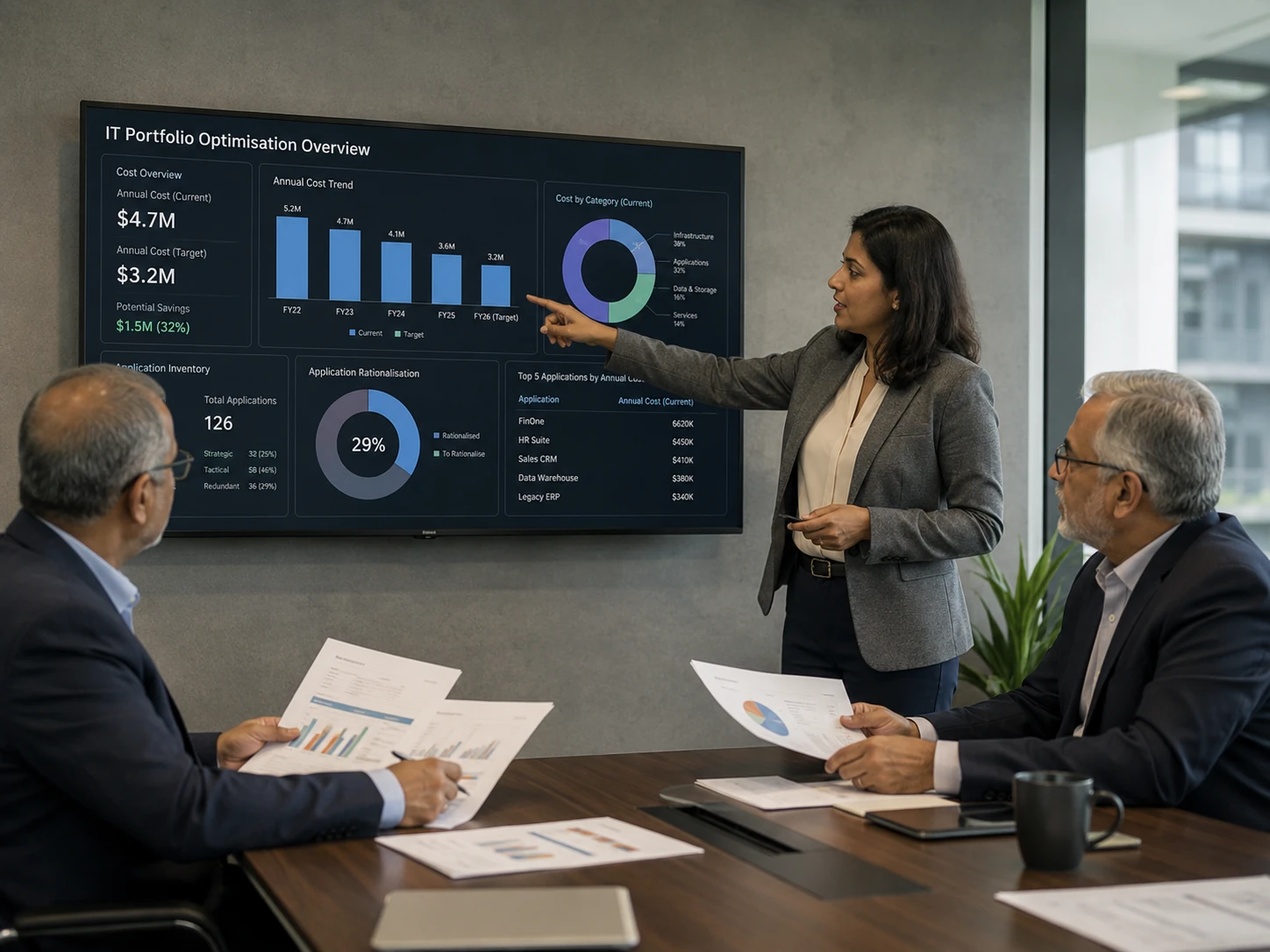
A complete inventory with usage, cost, ownership and overlap — and a realistic consolidation plan with the savings quantified.
Two registered business activities, four capability areas and eight defined services. Every engagement begins with the same question: what has to work better?
All servicesCapability areas group our services by the business outcome they support, not by the technology used to deliver them.
How it fits togetherTwo uncomfortable questions about the estate you are already running: how much of it is waste, and how much of it would stop the business if it failed on a Monday morning?
Nobody decides to run four tools that do the same job. It happens one reasonable decision at a time: a department buys something to solve an urgent problem, a trial subscription is never cancelled, an acquisition arrives with its own stack, a departing manager leaves a licence nobody can account for.
The same accretion produces fragility. Systems acquire dependencies on each other, on one supplier, on one server, or on one person — and the organisation only discovers which ones matter at the moment they fail.
This capability area addresses both: what the estate costs, and what it would cost you if part of it stopped.
Typical trigger: a finance review flags rising software subscriptions with no clear owner, or an outage — yours or a supplier's — makes it obvious that nobody has written down what depends on what.
Plotting the estate this way makes the decisions obvious. Expensive and uncritical is waste. Cheap and critical is exposure. The two quadrants demand opposite responses.
One reduces what the estate costs. One reduces what it could cost you. They share the same inventory work, so taking both together is usually cheaper.
Technology Operations & Resilience
A complete inventory with usage, cost, ownership and overlap — and a realistic consolidation plan with the savings quantified.
Technology Operations & Resilience
Critical services mapped to dependencies, recovery priorities agreed, fallback options identified and procedures written down.
What do we pay for software each year, and which three systems would hurt most if they stopped? If those answers are not readily available, this is the right capability area.