Capability area A1 · Activity 62012

BusinessOperationsSoftware

The system of record for work in progress — and the controlled window you open onto it for the customers, partners and suppliers who need to see part of it.

Case management Workflow Task tracking Secure portals Audit trail
What this capability covers

Work has to live somewhere other than an inbox.

Operational software exists to answer four questions at any moment: what came in, whose it is, what state it is in, and what happens next. Organisations that cannot answer those questions quickly are usually not disorganised — they simply have the information distributed across email, spreadsheets, notebooks and the memory of one long-serving colleague.

This capability area is about consolidating that into a single controlled record, then deciding carefully how much of it to expose to people outside the organisation.

Typical trigger: the organisation has grown past the point where one person can hold the whole picture, but not far enough to justify a large enterprise platform — and the gap is being filled by shared spreadsheets.

  • A single record per job, case, request or matter
  • Explicit ownership and explicit status at all times
  • History that shows who changed what, and when
  • Controlled external access without email chasing
  • Data structured so it can be reported on later
Capability diagram

The life of a work item.

Every operational system we build is, underneath, a set of permitted states and permitted transitions. Getting this right at the start is what stops the system drifting back into free text.

Work item state model A work item moves from received to triaged, assigned, in progress, on hold, review, and closed, with an audit trail recorded throughout and reporting drawn from closed items. Received Email, form, portal Triaged Type, priority, due Assigned Named owner In progress Tasks, notes, files Review Check before close Closed Outcome recorded On hold Waiting on a third party Reopened — returns to assignment with full history intact Audit trail written at every transition Who, what, when — for every record, permanently Feeds management reporting
Entry point Working state Terminal state Transition
Services in this area

Two services.

The internal system and the external window. They are frequently delivered together, but each stands on its own.

01 Colleagues reviewing a case management dashboard on office monitors Business Operations Software

Operations & Case Management Systems

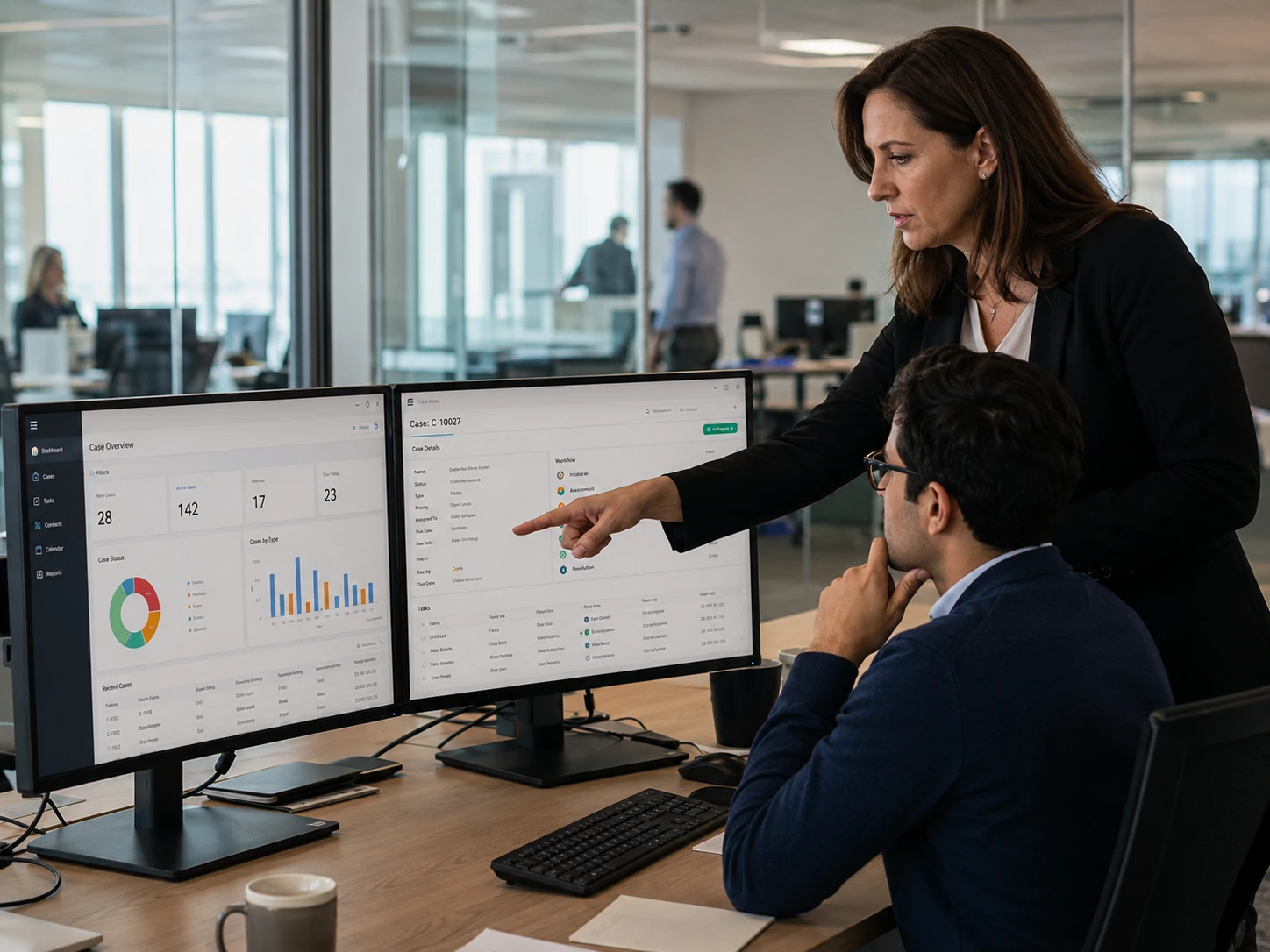
The internal system of record: cases, jobs, tasks, ownership, status, documents and history, with the workflow rules encoded once.

From£2,400 View service
Operations & Case Management Systems
02 Client using a secure partner portal on a laptop Business Operations Software

Customer & Partner Portal Systems

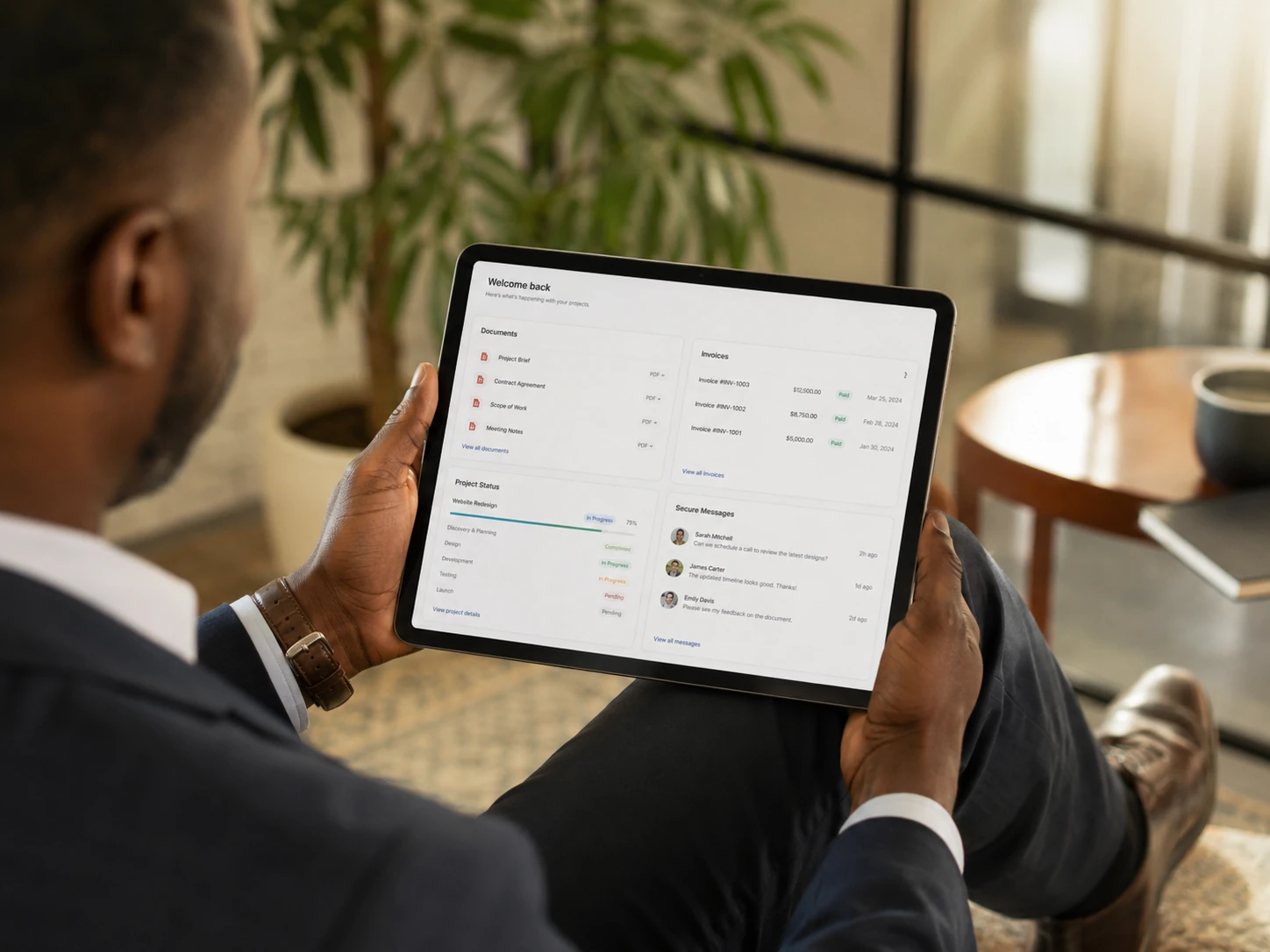
The external window: secure sign-in, request submission, document exchange, status visibility and a recorded conversation thread.

From£2,200 View service
Customer & Partner Portal Systems
Practical examples

What this looks like in different organisations.

The underlying model is the same. The vocabulary, the states and the rules are not.

Professional servicesMatter trackingEach piece of client work as a matter, with responsible fee earner, stage, deadlines, documents and a client-visible status summary.
Installation & tradesJob recordsSurvey, quote, scheduled job, engineer notes, photographs, sign-off and follow-up work, all against one job number.
Membership bodiesApplication handlingApplications received, evidence checked, panel decision recorded, outcome communicated and the whole chain retained for appeal.
Property & facilitiesReactive maintenanceReported faults triaged by urgency, assigned to contractors, tracked to completion, with tenant-visible progress.
Manufacturing supplySupplier requestsSuppliers submitting documentation, certificates and delivery notes through a portal instead of an overloaded shared mailbox.
Advisory & supportCasework with SLAsCases with response and resolution targets, escalation when they are missed, and reporting that shows where time is really going.
Common problems

What people describe before they call us.

  • 01“Nothing is lost, but nothing is findable”The information exists in email threads and attachments. Retrieving it takes twenty minutes and depends on who is asked.
  • 02“Two people worked on the same thing”Without explicit ownership, duplication is inevitable at volume — and so is the opposite, where everybody assumes somebody else picked it up.
  • 03“Clients ring us for updates”Status requests are a recurring administrative cost. They are also a symptom: if the client cannot see progress, often nobody internally can either.
  • 04“The handover is where things break”Work passing between teams loses context. A system that carries notes, files and decisions with the record removes most of that loss.
  • 05“We cannot prove what we did”In a dispute or a complaint, an assembled email chain is weak evidence. A timestamped, attributed record is strong evidence.
  • 06“Reporting takes a week every month”If reporting requires manual reassembly, the underlying operational data is not structured. Fixing the record fixes the reporting.
Start a conversation

Bring us the process that keeps going wrong.

Describe how a job currently moves through your organisation, including the parts that only work because somebody remembers to check. That conversation is where every operations system starts.